
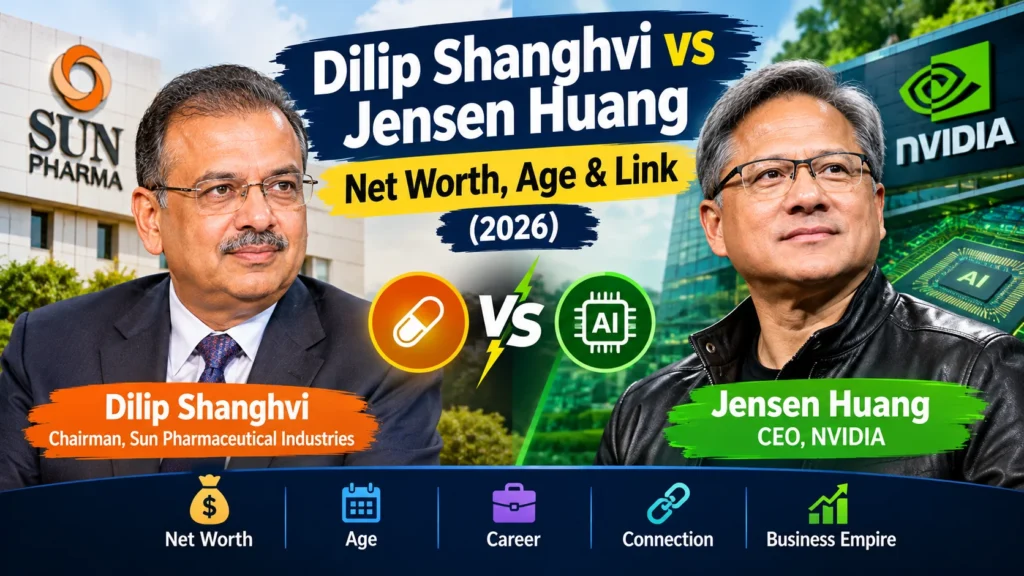
Type “Dilip Shanghvi and Jensen Huang” into a search bar and you’ll land on a dozen pages hinting that the two are linked. Here’s the straight answer: no verified link exists. One runs India’s largest drugmaker. The other runs the company selling the chips behind most of today’s AI. What they share is a place on the same billionaire rankings and a founder story that’s worth setting side by side. This guide covers who each man is, how old he is, how his company got where it is, and how the two fortunes compare, with a date attached to every money figure.
Quick answer
- Connected? No verified personal or business relationship found.
- Ages: Jensen Huang is 63 (born February 17, 1963). Dilip Shanghvi is 71 (born October 1, 1955).
- Net worth: On Bloomberg’s index in early October 2026, Huang sat at about $177 billion and Shanghvi at about $26.7 billion, roughly 6.6 times apart.
- Companies: NVIDIA (co-founded 1993) and Sun Pharmaceutical Industries (founded 1983).
- About the numbers: Net worth figures are estimates that move daily with share prices. Each one below is dated. Check Bloomberg or Forbes for today’s figure before you quote it.
Are Dilip Shanghvi and Jensen Huang Connected?
No, not as far as public records show. I looked for a shared board seat, a joint venture, a documented meeting, and any NVIDIA–Sun Pharma agreement. Nothing turned up, and the other pages ranking for this keyword reach the same conclusion.
So why do the names travel together? Three reasons seem likely, though this is my reading rather than a documented fact. Both appear on Bloomberg’s top-100 wealth ranking. Both are founders who still hold senior roles at the companies they started. And pair-comparison searches are a common pattern: people see two billionaires from different worlds and wonder how they stack up.
The nearest overlap is indirect. NVIDIA works with drugmakers on AI for drug discovery. Its June 2025 announcement with Novo Nordisk is one example. Sun Pharma is a drugmaker, but it isn’t named in that announcement, and I found no agreement between the two companies. If you come across a page claiming a deal, ask for a primary source such as a press release or a stock-exchange filing. A real partnership would show up in Sun Pharma’s exchange filings or NVIDIA’s newsroom first.
Side by Side
| Jensen Huang | Dilip Shanghvi | |
|---|---|---|
| Age | 63 | 71 |
| Born | February 17, 1963, Taiwan | October 1, 1955, Amreli, Gujarat, India |
| Company | NVIDIA (co-founded 1993) | Sun Pharmaceutical Industries (founded 1983) |
| Current role | Founder, President and CEO | Founder and Executive Chairman |
| Education | BS Oregon State, MS Stanford (electrical engineering) | Bachelor of Commerce, University of Calcutta |
| Industry | AI chips and computing | Generic and specialty pharmaceuticals |
| Spouse | Lori Huang (married 1985) | Vibha Shanghvi |
| Net worth (Bloomberg, early Oct 2026) | ~$177 billion | ~$26.7 billion |
Backgrounds and Career Timeline
Jensen Huang
Huang was born on February 17, 1963, so he’s 63. Sources disagree on the city: Wikipedia lists Taipei, while several profiles say Tainan. They all agree on Taiwan.
His early years read like a script no one would green-light. His mother taught her sons English by picking ten random dictionary words each day. When Jensen was nine, he and his older brother were sent to the United States to live with an uncle in Tacoma, Washington. At ten he was enrolled at the Oneida Baptist Institute in Kentucky. The family had understood it to be a prestigious boarding school. It was a reform academy, and Huang was badly bullied there. His parents reportedly sold nearly everything they owned to cover the tuition, then followed the boys to the US about two years later and settled in Oregon.
He finished high school at 16, earned an electrical engineering degree from Oregon State University and a master’s in the same field from Stanford. He started as a microprocessor designer at AMD (1984–85), then spent eight years at LSI Logic, where he ran a design group, before leaving to start NVIDIA. He has been married to Lori, whom he met at Oregon State, since 1985. They have two children, Madison and Spencer, who both work at NVIDIA (more in the FAQs).
Dilip Shanghvi
Shanghvi was born on October 1, 1955, in Amreli, Gujarat, which makes him 71. His father was a wholesale drug distributor, and Shanghvi grew up around the medicine trade, spending his youth in Kolkata. He graduated from the University of Calcutta with a commerce degree in 1982. Rather than keep selling other companies’ drugs, he decided to make his own.
In 1983 he started Sun Pharma with a small loan from his father (Forbes, as cited by other sites, puts it at about $200). The first products were psychiatric medicines; Bloomberg notes the company began with a drug for bipolar disorder. His wife is Vibha Shanghvi, and SEC filings by Taro Pharmaceutical, which Sun Pharma controlled, identify Sudhir Valia, a long-serving Sun Pharma director, as his brother-in-law. His story has also been told at book length: journalist Soma Das’s The Reluctant Billionaire (2019) is described as the first biography of him.
Career timeline
| Year | Jensen Huang / NVIDIA | Dilip Shanghvi / Sun Pharma |
|---|---|---|
| 1955 | Born, October 1 | |
| 1963 | Born, February 17 | |
| 1983 | Founds Sun Pharma | |
| 1993 | Co-founds NVIDIA | |
| 1994 | Sun Pharma goes public | |
| 1997 | First overseas purchase: Caraco, Detroit | |
| 1999 | NVIDIA introduces the GPU | |
| 2006 | Launches CUDA | |
| 2012 | AlexNet shows what GPU-trained deep learning can do | |
| 2015 | Completes Ranbaxy deal (announced 2014) | |
| 2022 | $50 million gift to Oregon State (with Lori) | |
| 2025 | NVIDIA becomes the first company valued at $5 trillion | Checkpoint Therapeutics deal completed |
| 2026 | Fiscal 2026 revenue of $215.9 billion | Announces Organon deal (April) |
How Each Built the Company
Huang and NVIDIA
In 1993, at 30, Huang co-founded NVIDIA with Chris Malachowsky and Curtis Priem. The founding meeting famously took place at a Denny’s restaurant. The company made graphics chips for video games and had a rough start.
Three dates explain most of what came next. NVIDIA introduced the GPU in 1999. In 2006 it launched CUDA, software that let developers use GPUs for general-purpose computing, not just graphics. In 2012 a neural network called AlexNet, trained on GPUs, helped show what deep learning could do. NVIDIA spent years building the software and hardware that AI later needed, and that groundwork is why the AI boom landed on its doorstep.
For fiscal 2026 (ended January 25, 2026), NVIDIA reported record revenue of $215.9 billion, up 65% from the year before, with data center sales of about $193.7 billion. It returned $41.1 billion to shareholders in buybacks and dividends that year. In October 2025 it became the first company to reach a $5 trillion valuation. Outside recognition followed: Time named Huang to its most-influential list in 2021 and 2024, and Fortune made him Businessperson of the Year in 2017.
Shanghvi and Sun Pharma
Shanghvi’s playbook is different. He buys companies, often troubled ones, and fixes them. Sun Pharma went public in 1994 and made its first overseas purchase, Caraco in Detroit, in 1997. Bloomberg counts 13 drugmakers acquired since then. Taro Pharmaceutical, bought in stages, nearly doubled Sun’s US revenue.
The biggest early bet was Ranbaxy, announced in 2014 and completed in 2015. Ranbaxy was in trouble with the US FDA at the time, which made investors nervous, and the deal made Sun Pharma India’s largest drug company. The price depends on who’s counting: Bloomberg and Britannica say about $3.2 billion, while Forbes (as cited by other sites) puts it near $4 billion. Later deals included Concert Pharmaceuticals (2023) and Checkpoint Therapeutics (completed in 2025; reported values range from roughly $355 million to $416 million depending on how contingent payments are counted). In 2025, Kirti Ganorkar became Managing Director while Shanghvi stayed on as Executive Chairman. He has also chaired the IIT Bombay board of governors and received the Padma Shri in 2016.
The Organon deal
On April 26–27, 2026, Sun Pharma announced a deal to buy US-listed Organon, spun out of Merck in 2021, for $14 per share in cash. That implies an enterprise value of $11.75 billion and an equity value near $3.99 billion, making it Sun Pharma’s largest overseas acquisition.
The companies say the combined business would have about $12.4 billion in revenue, rank among the world’s top 25 drugmakers, move Sun Pharma into biosimilars, and make it a top-three player in women’s health. Funding comes from cash and committed bank loans, with net debt expected at about 2.3 times EBITDA afterward. The deal needs regulatory approvals and Organon shareholder consent, and closing is expected in early 2027. Until then it’s a pending deal, not a done one.
Net Worth and Company Scale
Who is richer, and by how much
Huang, by a wide margin. Here is every figure that could be pinned to a tracker and a day.
| Source | Jensen Huang | Dilip Shanghvi |
|---|---|---|
| Bloomberg Billionaires Index, early October 2026 | ~$177 billion | ~$26.7 billion (ranked #91) |
| Forbes real-time, September 2026 (as cited by a secondary site) | ~$187.4 billion (Sept 16) | ~$26.4 billion (Sept 10) |
Forbes’ annual list on March 1, 2026 put Shanghvi at about $25.6 billion (as cited by secondary sites).
On Bloomberg’s numbers, taken the same day from the same tracker, Huang is worth about 6.6 times as much as Shanghvi. The Forbes pair works out to about 7.1 times, but those two dates are six days apart, so the Bloomberg ratio is the more reliable one. Some other pages put Forbes’ figure for Huang above $200 billion in 2026. Forbes’ live number moves daily, so check it on the day you publish.
Why Forbes and Bloomberg differ. Both trackers estimate stakes in public companies and then adjust for private holdings, debts and taxes in their own ways. A few billion dollars of difference is normal, and either figure can move by the hour. That’s why a number without a date is nearly useless. Some auto-generated pages still list Huang at $10–12 billion, which is out of date by more than a decade of NVIDIA growth.
Why one fortune swings more. Huang’s wealth is mostly NVIDIA stock, and NVIDIA’s value has been driven by AI demand. Bloomberg’s index shows his fortune up about $19.4 billion over the past year. A simple illustration: a 5% move in the value of his holdings is roughly $9 billion, about a third of Shanghvi’s entire fortune. That’s arithmetic on the Bloomberg figure, not a forecast.
Shanghvi’s fortune has swung too, at times downward. Bloomberg reported in 2019 that he’d lost about $17 billion during an upheaval in the generic-drug business, along with the title of India’s richest person. His wealth rests mainly on a controlling Sun Pharma stake, plus about 66% of Sun Pharma Advanced Research Company (SPARC) and interests such as Suzlon Energy.
Company scale, same period
| NVIDIA | Sun Pharma | |
|---|---|---|
| Founded | 1993 | 1983 |
| Latest fiscal year | Ended January 25, 2026 | Ended March 31, 2026 |
| Revenue | $215.9 billion | ₹58,220 crore (roughly $6.5–7 billion at recent exchange rates) |
| Revenue growth | +65% | +11.9% |
| Founder’s role | Founder, President, CEO | Founder, Executive Chairman |
NVIDIA’s latest annual revenue is more than 30 times Sun Pharma’s. Sun’s own results show where its growth comes from: its Innovative Medicines business passed $1 billion in sales in fiscal 2026 (about $1.42 billion), and India remains its largest market. That gap in scale, more than any difference in talent, explains the wealth gap. Pharma is a steady, regulated business with modest margins on generics. AI chips, for now, are in a demand surge.
Huang’s Homes and Giving
Searches for Huang’s lifestyle are common, so here is the short, sourced version. Reported by the Wall Street Journal and others, his known property portfolio is modest next to his fortune, at roughly $53 million in total.
| Home | Bought | Reported price | Notes |
|---|---|---|---|
| Los Altos Hills, California | 2003 | $6.9 million | About 15 miles from NVIDIA’s Santa Clara headquarters |
| Wailea, Maui, Hawaii | 2004 | $7.5 million | Oceanfront, seven bedrooms, nearly 8,000 sq ft, in a gated community |
| Pacific Heights, San Francisco | 2017 | About $38 million | About 11,400 sq ft, Golden Gate Bridge views |
He has also given. In October 2022, Huang and Lori donated $50 million to Oregon State University, their alma mater, toward the Jen-Hsun and Lori Huang Collaborative Innovation Complex, a planned $200 million research and education center with an AI supercomputer. The couple had earlier given $30 million for an engineering center at Stanford.
Leadership, Challenges and Lessons
This section is my analysis, not reported fact.
Huang makes long bets on a technology platform. CUDA launched in 2006, six years before AlexNet and well over a decade before the AI boom paid it off. He held a direction through years when the payoff was invisible to most outsiders. Shanghvi makes disciplined bets on assets other people are nervous about. Ranbaxy came with regulatory baggage; investors still bought into the idea because they trusted his record. He’s also known for a low public profile, while Huang’s keynotes and black leather jacket are part of NVIDIA’s brand.
Both faced real setbacks. NVIDIA had a rough start in a crowded graphics market, and Sun Pharma has dealt with US FDA scrutiny and the work of integrating troubled acquisitions.
Three lessons stand out for entrepreneurs:
- Be patient. Both men spent decades before their companies reached global scale.
- Back your bet through uncertainty. CUDA and Ranbaxy both looked doubtful when they were made.
- Keep evolving. Neither relied on one product. NVIDIA moved from games to AI, and Sun moved from psychiatric drugs to specialty medicines and, if the Organon deal closes, biosimilars and women’s health.
The common thread is staying power. Both are founders still in senior roles after decades, which is rare at this scale.
FAQs
Are Dilip Shanghvi and Jensen Huang connected?
No verified connection exists. They run companies in unrelated industries, and any claimed partnership should be treated as unconfirmed until a company filing or press release backs it.
How old is Dilip Shanghvi?
He was born on October 1, 1955, so he’s 71.
How old is Jensen Huang?
He was born on February 17, 1963, so he’s 63.
Who is richer, Dilip Shanghvi or Jensen Huang?
Jensen Huang. On Bloomberg’s index in early October 2026, he was at about $177 billion against about $26.7 billion for Shanghvi.
What is Dilip Shanghvi’s net worth in 2026?
About $26–27 billion across Bloomberg and Forbes readings from September and October 2026, and about $25.6 billion on Forbes’ annual list as of March 1. It changes with Sun Pharma’s share price.
What is Jensen Huang’s net worth in 2026?
Bloomberg showed about $177 billion in early October 2026. A secondary site cites Forbes at about $187.4 billion in mid-September. The gap reflects different trackers and dates.
Where does Jensen Huang live?
He is based in the San Francisco Bay Area. He owns an estate in Los Altos Hills near NVIDIA’s headquarters and a mansion in San Francisco’s Pacific Heights, and reports differ on which one is his main home. He also owns an oceanfront home in Maui.
Do Jensen Huang’s children work at NVIDIA?
Yes. His daughter Madison joined NVIDIA in 2020 and is a senior director in its simulation software (Omniverse) work. His son Spencer joined in 2022 and works in robotics.
Has Jensen Huang donated to charity?
Yes. He and his wife gave $50 million to Oregon State University in October 2022 and earlier gave $30 million for an engineering center at Stanford.
Is Sun Pharma partnering with NVIDIA?
I found no such partnership. NVIDIA has announced drug-discovery AI work with other pharma companies, such as Novo Nordisk, but Sun Pharma isn’t named in them.
Conclusion
Shanghvi and Huang are best read as parallel stories rather than connected ones. One spent four decades buying and fixing drug companies until his own became India’s biggest. The other spent three decades betting on a chip architecture until it became the engine of the AI era. No public evidence ties them together, and the gap between their fortunes comes mostly from the businesses they chose, not from any difference in effort.
DISCOVER MORE ARTICLES
Lachlan Murdoch & David Cordani: Are They Connected? (2026)
Is Peter Orszag Bald? The Truth About His Hair in 2026
Selena Gomez and Jeff Greene: The Truth Behind the Link

Shahzad is the founder and lead writer at WorthRada. He writes about celebrity net worth, biographies, careers, income, and success stories, with a focus on providing clear, well-researched, and reliable information.